History
Much of the historical record presented here is drawn from Affordable Dreams: The Goetsch-Winckler House and Frank Lloyd Wright, the most comprehensive study of the Goetsch–Winckler house and its original owners, along with additional research from period articles and academic work, including publications in Old House Journal, Women’s Art Journal, SaveWright magazine, as well as a terrific undergraduate thesis by Calli Verkamp from the University of Arkansas, Fayetteville.
We are deeply indebted to the authors and researchers whose work has helped preserve the home’s history. Without their efforts, much of this record would likely have been lost to time. To say that we are grateful would be an understatement.
Last updated May 4, 2026.
Before Wright
Alma Goetsch (1901–1968) and Kathrine Winckler (1898–1976) were both born and raised in Wisconsin at the turn of the twentieth century. Awareness of Frank Lloyd Wright’s work and architectural philosophy was not uncommon among artistically inclined Wisconsinites, but Winckler had a particular advantage: her father had been Wright’s classmate at the same grade school she herself later attended.1
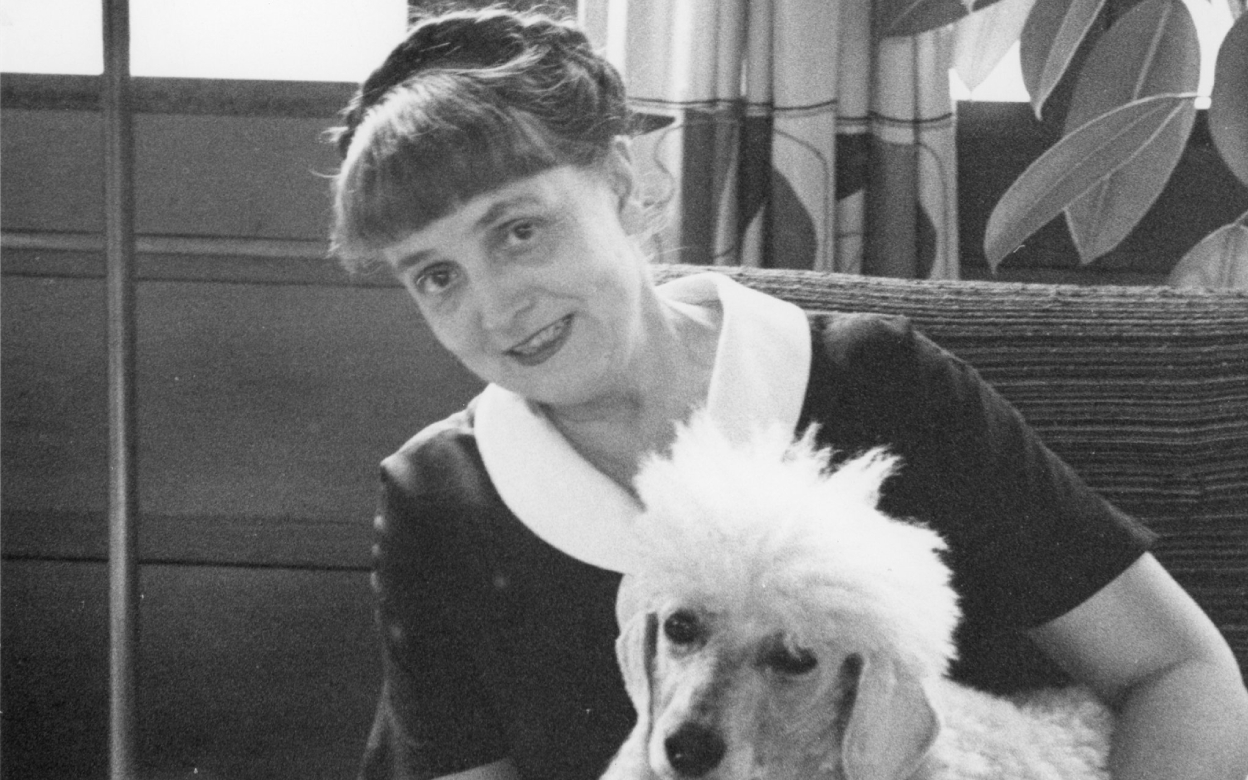
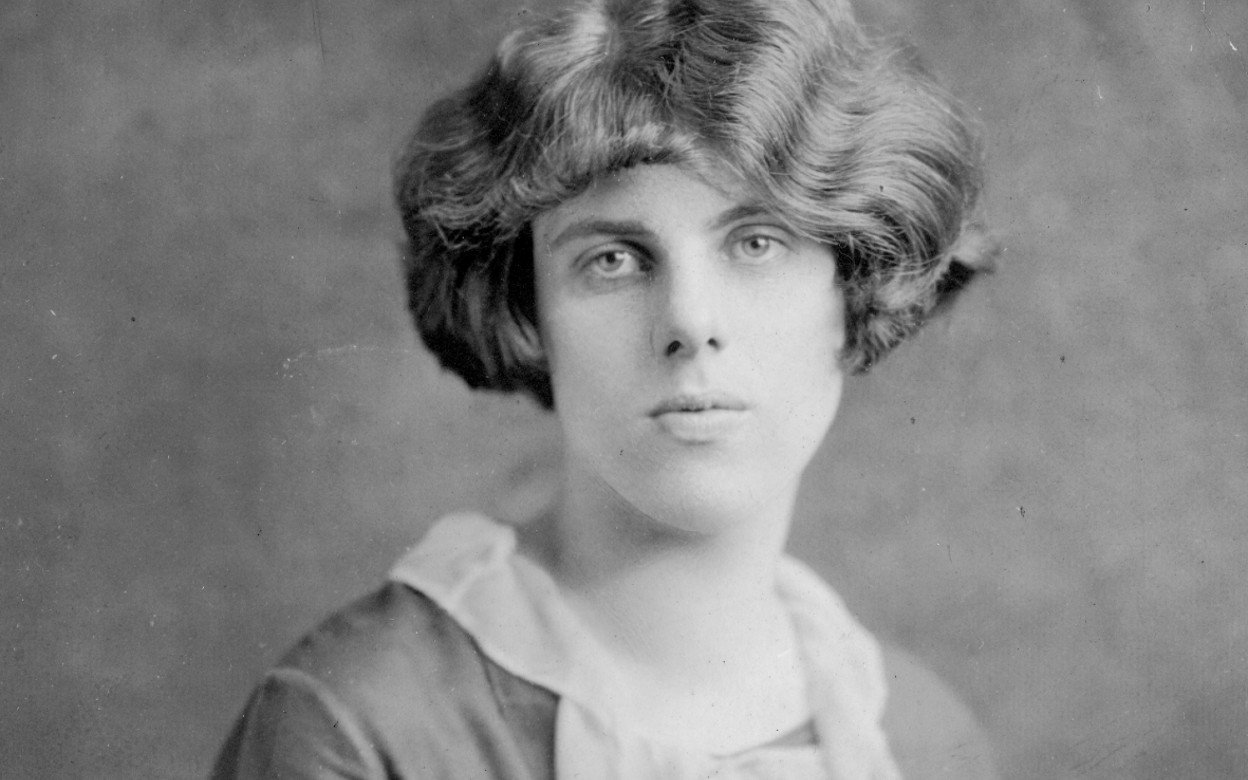
Portraits of Alma Goetsch (with Littlebit) and Kathrine Winckler.
Courtesy the Michigan State University Archives and Historical Collections.
Goetsch and Winckler both valued independence, free thought, and social consciousness, and were among the many tenacious Midwestern women of their generation who earned college degrees.
Winckler received her Bachelor of Arts from the University of Wisconsin in 1921 and started her career in Chicago, where she worked for several years as a commercial artist. At around the same time, Goetsch enrolled at the Art Institute of Chicago, where she earned a Bachelor of Arts in Education in 1928.2
In 1926, Winckler moved to Michigan to teach art at Michigan State University (then Michigan Agricultural College). Two years later, Goetsch accepted a similar position—and it was there that the two women met, beginning a lifelong partnership that would shape both their personal and professional lives.3

Kathrine Winckler, “Still Life with Sculptures”, oil on Masonite, unknown year.
Notably, at the time, it was considered “improper” for unmarried women to live alone. According to Winckler’s sister, Salome Winckler Wells, the two women began living together as roommates in 1931 after finding a suitable apartment to share.4
However, they remained dissatisfied with their living conditions. As Winckler later wrote, “All my life I have resented the little holes in walls that people call windows.”5
Both women were deeply familiar with Frank Lloyd Wright’s work and architectural philosophy, and long dreamed of commissioning a home that embodied his ideals. It was a dream that seemed unattainable—that is, until Wright developed the first moderate-cost Usonian house. Only then did they “dream that heaven was within our reach.”6
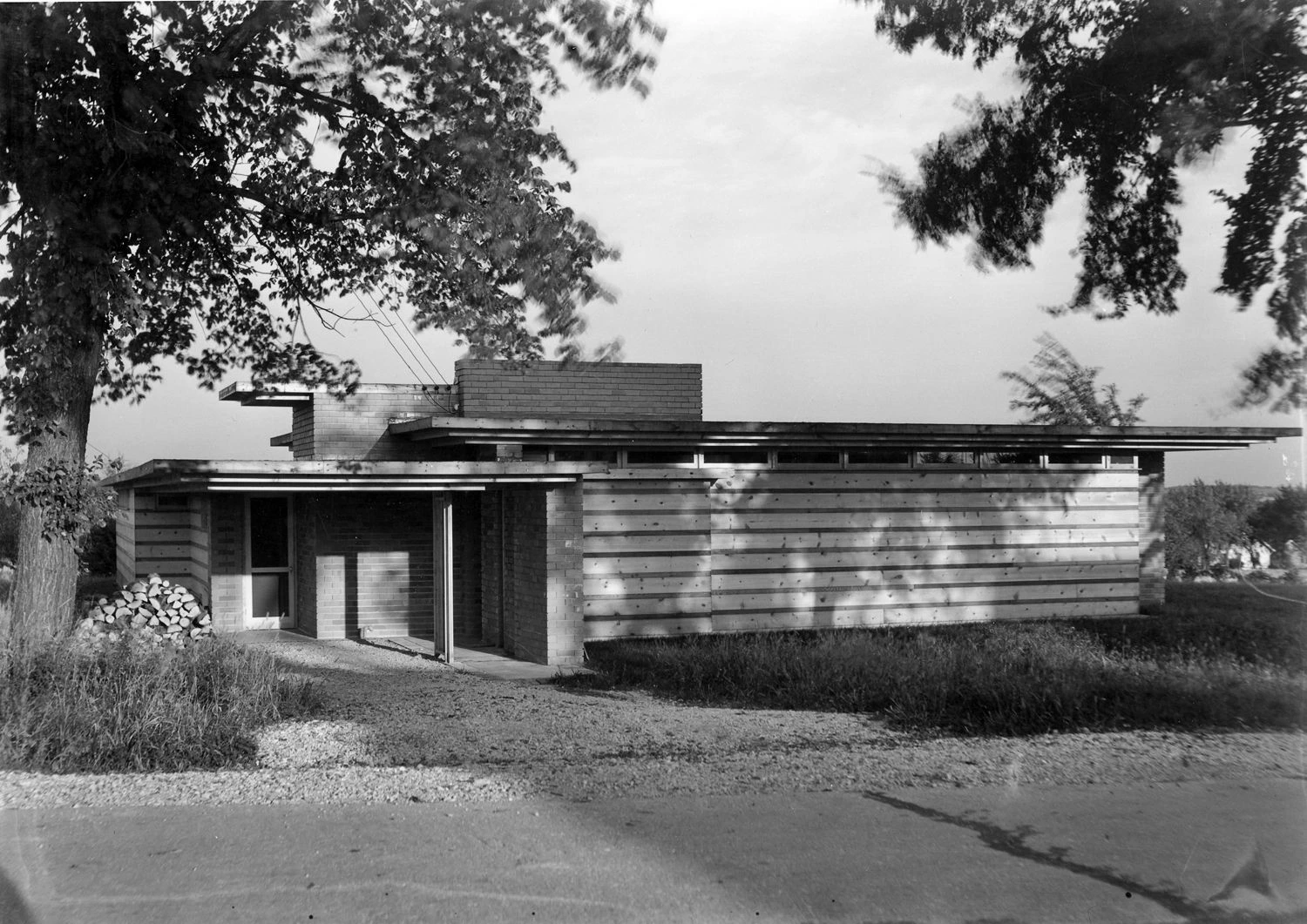
Street view of the Jacobs House / © The Estate of Pedro E. Guerrero.
Winckler became a frequent visitor to the Jacobs House in Wisconsin, Wright’s first Usonian design, admitting, “I finally became apologetic about it.”7 She also consulted Wright directly about building a home, but when the opportunity arose to participate in a cooperative housing project near Michigan State, the dream they had long cherished finally seemed possible.
Usonia II
Michigan State’s first encounter with Wright was in 1935 when the landscape architecture department at Michigan State invited him to campus. There he delivered a lecture on organic architecture titled “In the Nature of Materials,” where he discussed the importance of harmony between structure and environment.8
Just a few years later, in the wake of the Great Depression, campus housing remained scarce and was dominated by Colonial Revival, Tudor, and generic “builder’s box” styles—like Goetsch and Winckler’s apartment. Seeking alternatives, Michigan State professors Sidney Newman and Harold Fields optioned forty acres at the southeast edge of the Michigan State campus to establish a cooperative of modestly priced homes for faculty.9
Early participants, including members of the art department such as Goetsch and Winckler, were especially enthusiastic about Wright’s work and conveyed their interest to Newman, who was receptive to the idea of using some of the land to build a small Usonian community. By August 1938, seventeen acres were reserved for homes designed by Wright, with plans for seven houses arranged around a central caretaker’s cottage.10
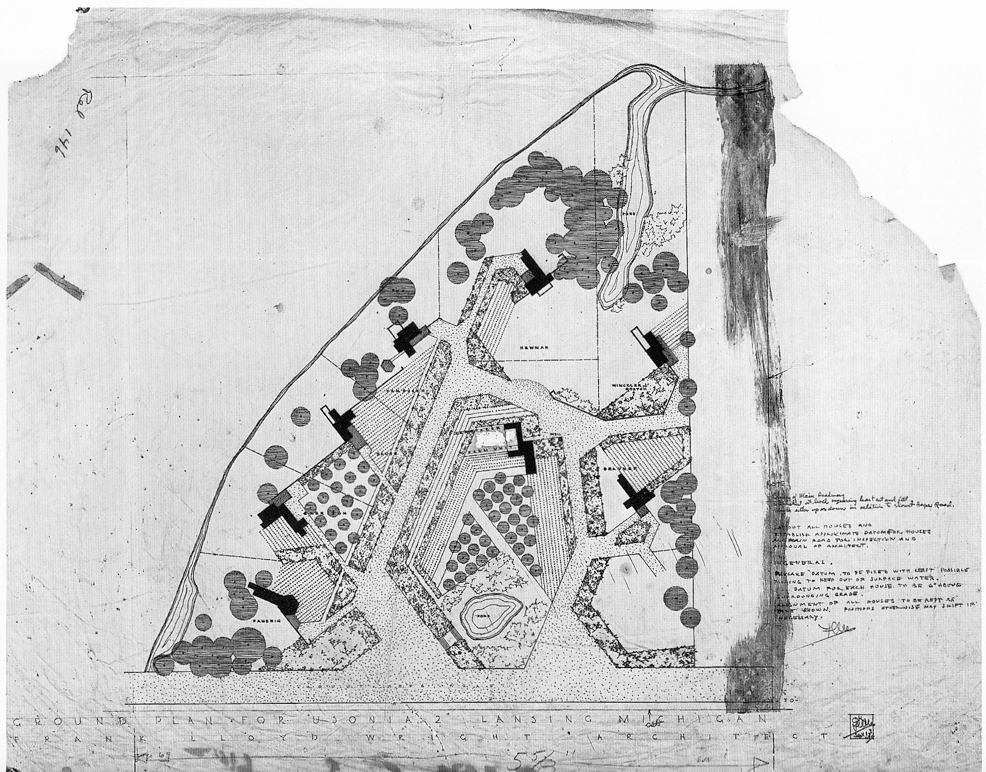
Courtesy the Frank Lloyd Wright Foundation, Scottsdale, AZ.
In their correspondence with Wright’s office, the group understood that, while Wright insisted on creative freedom, he still needed to understand his clients’ daily lives. Each participant penned a letter describing their family, routines, interests, and idiosyncracies so that they might be taken into account in his designs.11
Goetsch and Winckler introduced themselves as energetic art teachers in their forties with “a common desire to have you build a house for us.” Winckler noted, “I am unhappy unless I can cross my long legs under the table,” and she recalled her awe at the view from the Jacobs House bedroom:
“… the earth and trees and sky all at once.”12
Goetsch admitted some unease “moving to the country” and asked Wright to design a bedroom that felt secure: “Although I am only 5’2", I manage to fight my battles all right while awake.” She also added, “Please put a few pantry shelves down where I can reach them.”13
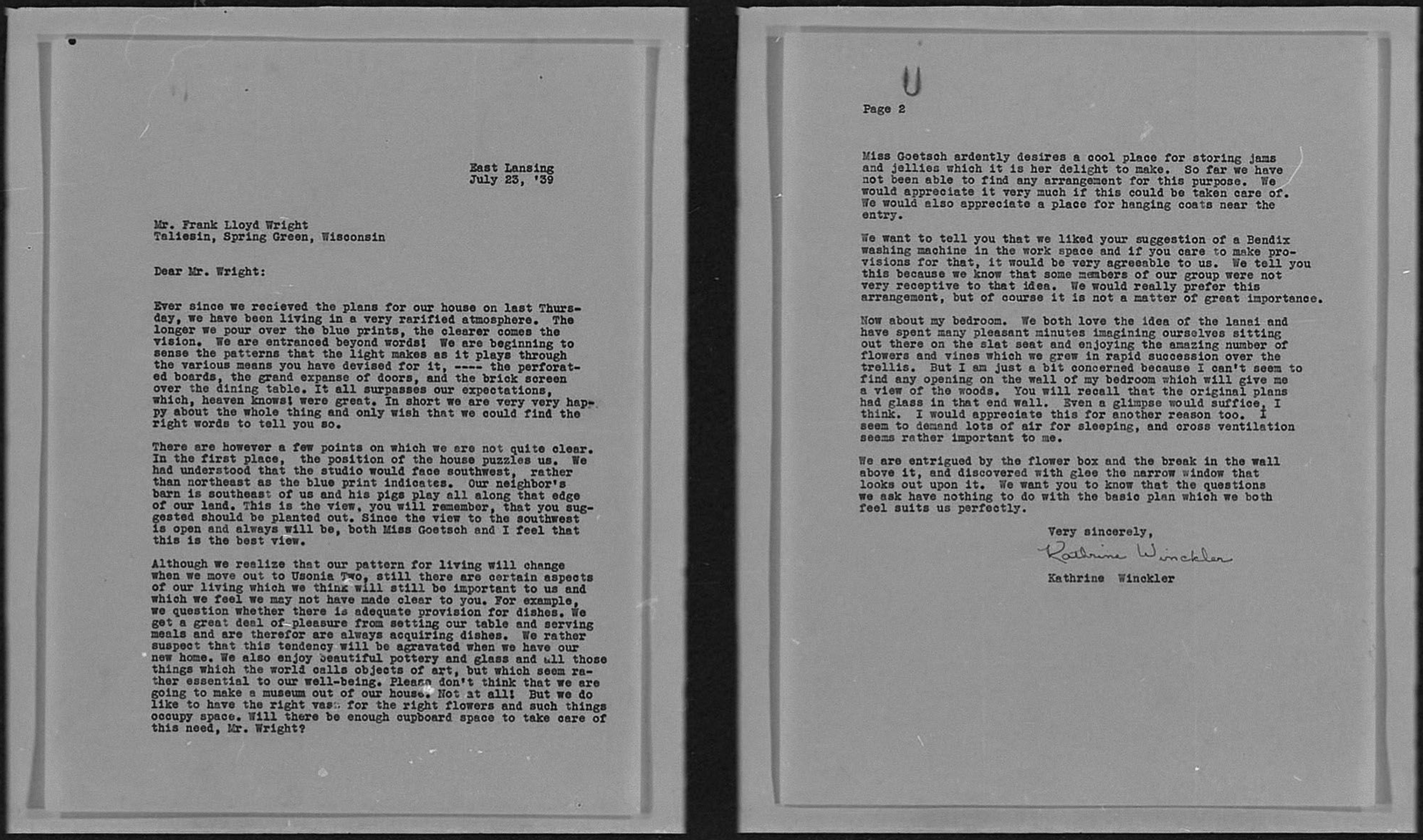
Letter to Wright from Kathrine Winckler, July 25, 1939, Columbia University Archives
The cooperative hired Harold Turner, a Danish-American builder who had previously worked with Wright on several other Usonian homes, to supervise the project and turn Wright’s designs into reality.14
Unfortunately, in September 1939, just as construction was to begin, the project’s financier withdrew. Despite efforts—including Wright’s direct appeal to the Federal Housing Authority—no lender was willing to back the venture. By mid-1940, the project was abandoned.15
Goetsch and Winckler remained undeterred. They secured their own financing by pooling their savings and using Winckler’s mother’s home as collateral.16 In all, they budgeted $6,600 for the construction of their home—equivalent to about $150k in 2025.17 They then wrote to Wright, “We have our money. When may we start?”18
But there was a problem: the piggery next door. The vacant lot adjacent to the planned site for Goetsch and Winckler’s home was being used by the city of East Lansing as a garbage dumping ground, and a hog wallow sat nearby where pigs were fed trash.19
Dissuaded, the women purchased a more “attractive” plot of land in April 1940, with similar terrain about a mile southeast of the original site, and broke ground two months later on June 4.20
They quickly sent a letter to inform Wright of their progress: “Our house is started!”21
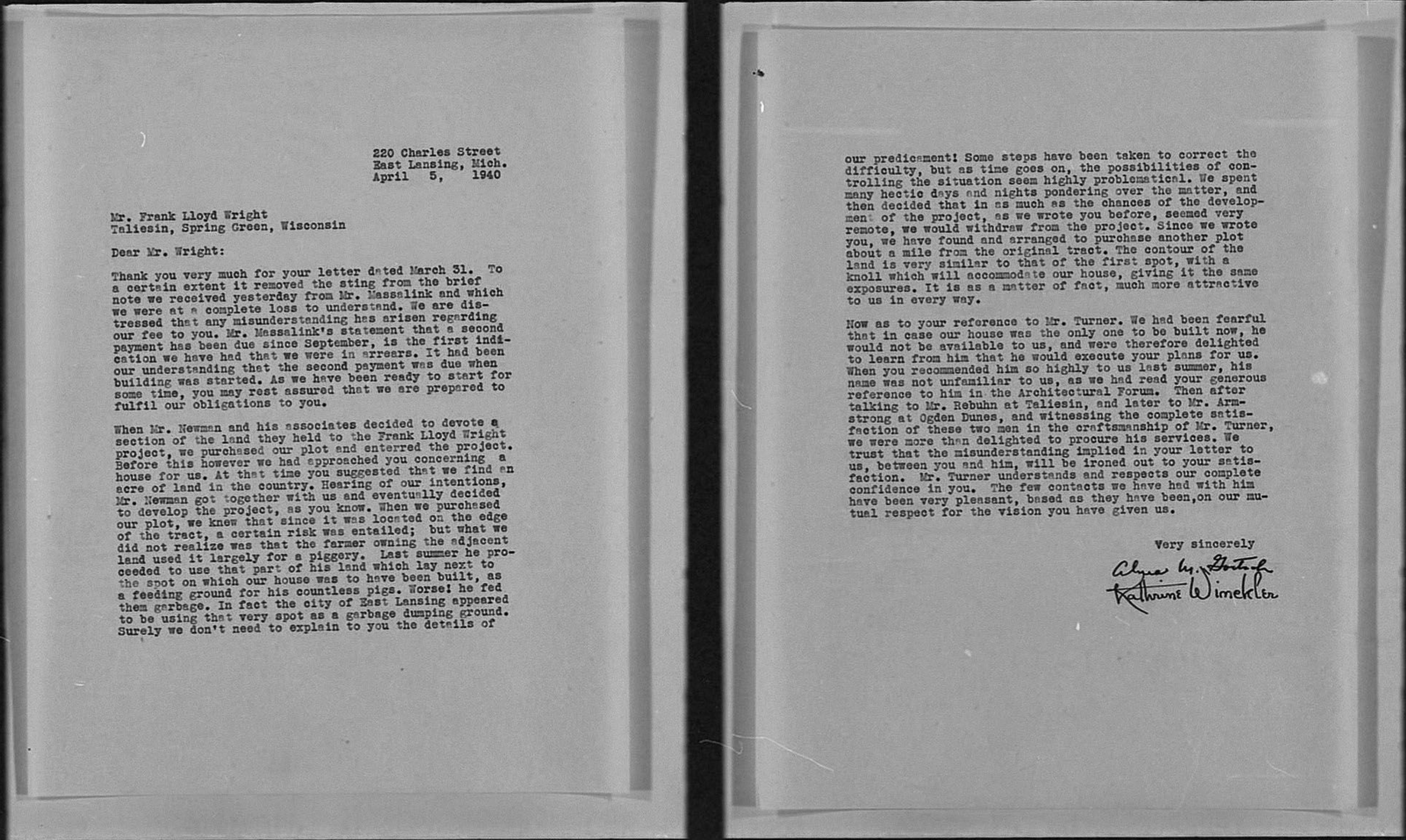
Letter to Wright from Goetsch and Winckler, April 5, 1940, Columbia University Archives
Construction Begins
Of all the participants in the Usonia II project, Goetsch and Winckler made the fewest specific requests. The two had an intimate familiarity of Wright’s work and philosophy, and trusted in his expertise to create a home that would meet their every need without detailed direction.22
To accommodate their love of entertaining and various artistic pursuits within a modest footprint, Wright designed an open, airy space flanked by friezes of windows. He called this central area the “Studio-Living Room.”23 The open floor plan subtly defined distinct yet interconnected areas, including a snug corner for reading and conversation centered around a warm, inviting hearth.
The dining table system was designed to be modular, with four mobile sections that could serve as individual tables or extend the built-in units for dining or creative work. The result was a flexible and thoughtfully designed interior that functioned with elegance and ease.
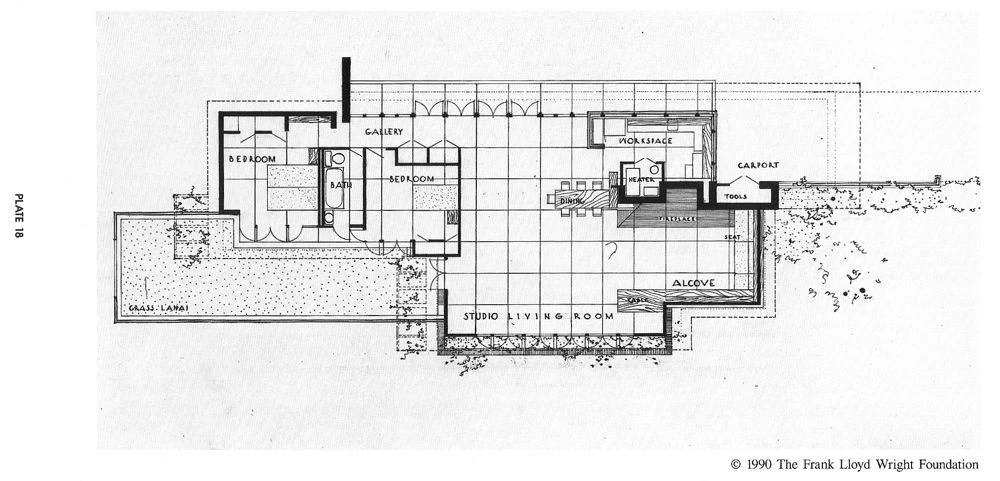
Goetsch–Winckler floorplan / © 1990 The Frank Lloyd Wright Foundation
Goetsch and Winckler were perfectly suited for the informal style of living and entertaining, but while Goetsch and Winckler were “entranced beyond words” when they received their blueprints for the home, there was one thing that was missing: a place to store their jams and jellies.24
Goetsch and Winckler had asked Wright for a cool place in which to store preserves, but he repeatedly declined, urging them to find “alternative arrangements.” The women were unable to do so, and neither had they found adequate storage for their dishes, pottery, and glass.25
Frank Lloyd Wright was well-known for avoiding cellars and garages, believing such spaces encouraged clutter.26 Although some later Usonian homes did incorporate cellars, the Goetsch–Winckler House—especially as one of his earliest Usonian designs—reflected Wright’s unwillingness at the time to compromise on his principles.
Instead, they turned to their builder, Harold Turner.
“Disturbing Changes”
Turner, in striving to make his clients happy, conceived of a means to make their request for a root cellar a reality: he cleverly converted the outdoor “Tool Storage” cabinet into a staircase which led down to an excavated area underneath the carport which could be used as a cool place to store their preserves.27
Goetsch and Winckler were pleased, and made yet another request of Turner: they asked that the water heater and boiler be relocated. Although Wright had originally planned for the utilities to be located in a niche in the kitchen workspace, Goetsch and Winckler feared that they would take up too much space.
So, Turner again excavated a second area under the home—this time beneath the studio-living room—which was used to accommodate the water heater and boiler. This space was made accessible via a hidden brick door cut into the east wall of the brick planter box. As a result, Goetsch and Winckler’s kitchen, which was already quite generous by Wright’s standards, became even more spacious—a rarity among Usonian designs, whose kitchens (or “workspaces”) were notoriously quite cramped.
As construction continued, Turner quickly realized that costs were projected to exceed Goetsch and Winckler’s budget. To keep expenses within limits, several other unplanned modifications were made.
Turner informed Wright that he needed to substitute the specified cypress siding with cheaper and more easily-sourced redwood. The ceiling, originally designed with thin redwood boards, was replaced with four-foot-square oiled plywood panels (a novel building material in the 1930’s). To further economize, he omitted the decorative perforated boards—sometimes called “shadow screens”—that were intended for the clerestory windows.28
Harold Turner’s alterations ultimately proved effective: the home was completed with just $5.27 to spare29—a rare and possibly singular example of a Wright-designed home that did not exceed its budget.
However, upon learning of the modifications and the two unsanctioned excavated spaces, Wright was less than pleased. When Goetsch and Winckler traveled to Taliesin on August 15 to express their appreciation for the home to Wright in person, they were instead met with a letter ordering them to stop paying Turner, “until I have a chance to do the work necessary to put the work back in proper form.” Wright then went so far as to threaten that he would refuse to recognize the house as an authentic work.30
Goetsch and Winckler, however, stood by Turner’s integrity and urged Wright to see their house for himself declaring “We feel now that we have one of the very finest [Frank Lloyd Wright houses].”31
In a rare concession, Wright relented after speaking with Turner directly:
“Dear Misses Goetsch and Winckler: Harold Turner came down today and explained the disturbing changes in the house. If he had done so before a great deal of unpleasant feeling would have been saved. I hope some day before long to come myself to see the work. Meantime the status quo is restored.”32
In the fall of 1941, Wright did just that, and reportedly later christened the home his “favorite small house.”33
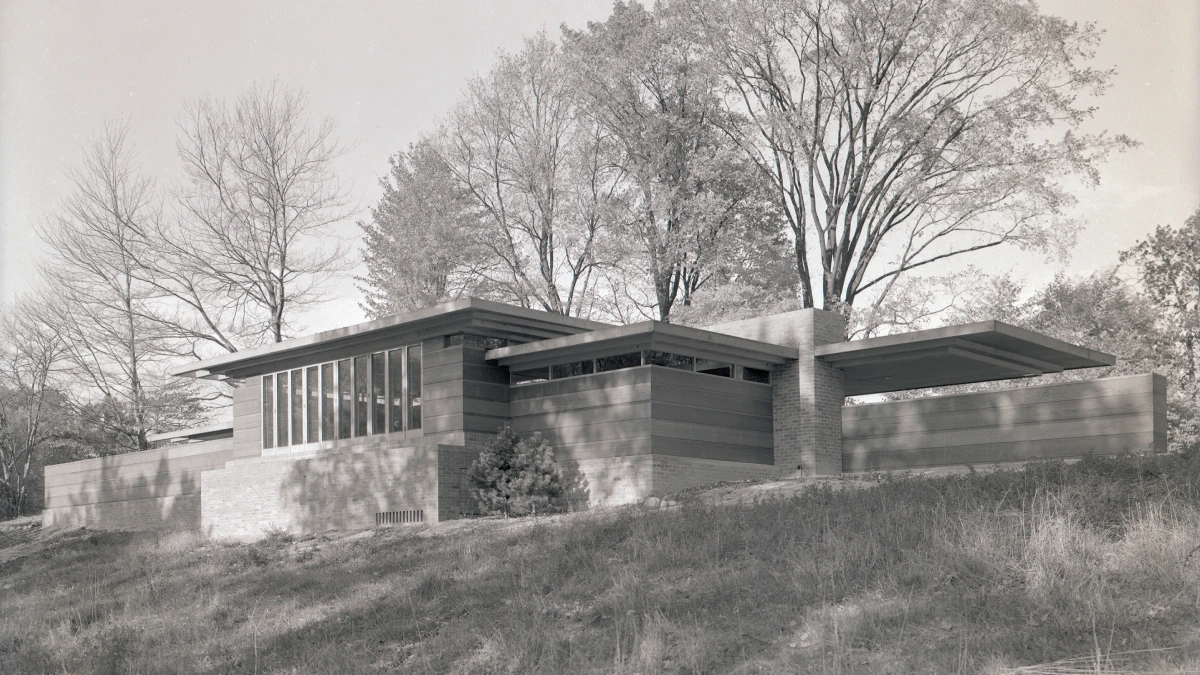
“Goetsch-Winckler house”, Oct. 19, 1940. Cropped from original.
Courtesy the Archives of Michigan Digital Collections.
Earth and Trees and Sky
At last, what had so moved Winckler at the Jacobs House was now hers: earth and trees and sky all at once.
The resulting structure embraced simplicity and efficiency, featuring an open floor plan, built-in furniture, and large windows that connected the interior to the surrounding landscape. The house reflected Wright’s belief in creating spaces that encouraged harmony between people and their environment, aligning perfectly with Goetsch and Winckler’s modernist values.
Widely considered one of Wright’s most elegant Usonian homes in both form and function, the Goetsch–Winckler house is a quintessential example of Wright’s vision for decentralized, affordable, and harmonious American living for the everyman—and everywoman.
Unadulterated by the excesses of the postwar economic boom, the house is free of superfluous ornamentation and unnecessary extravagance. It is a house stripped to its bare essentials—unapologetically simple in construction, yet exquisite in form and entirely functional.
More than a model of Usonian design, the house reflects Wright’s belief that dignified, affordable housing should be accessible to those of modest means.
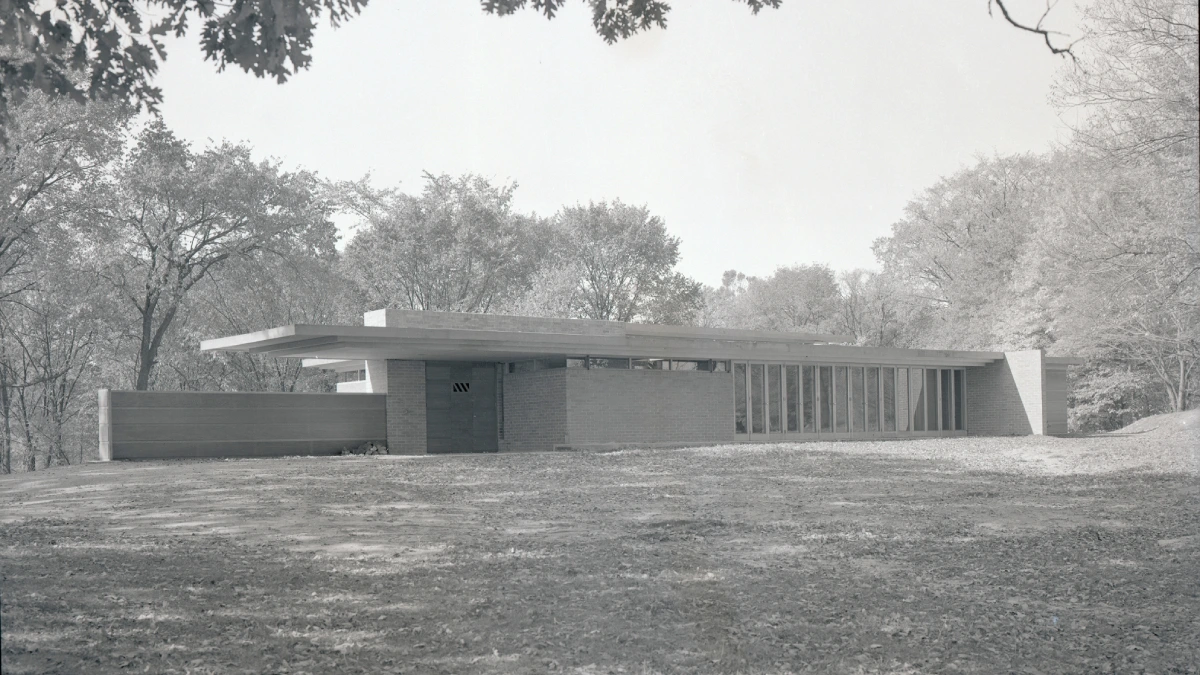
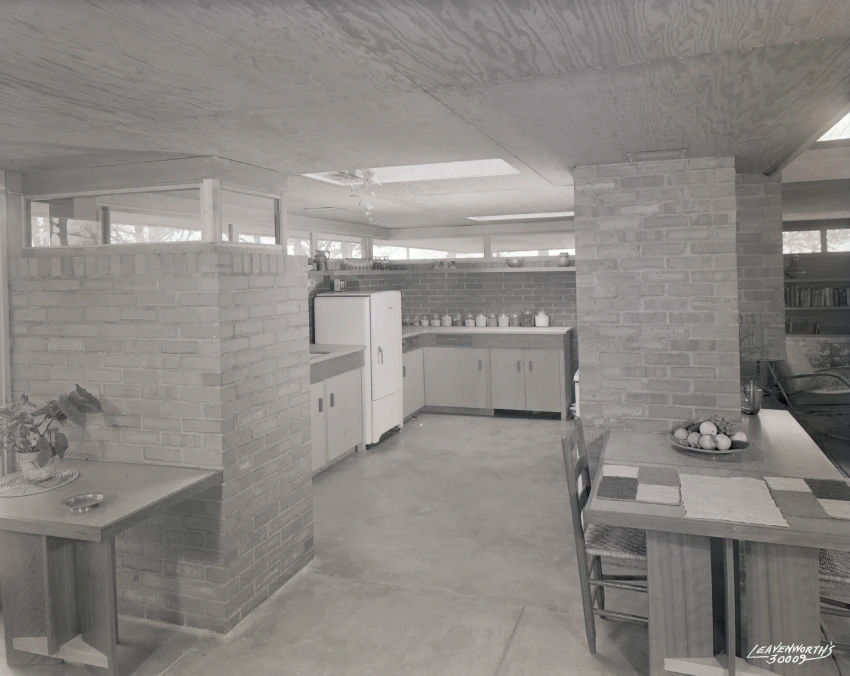
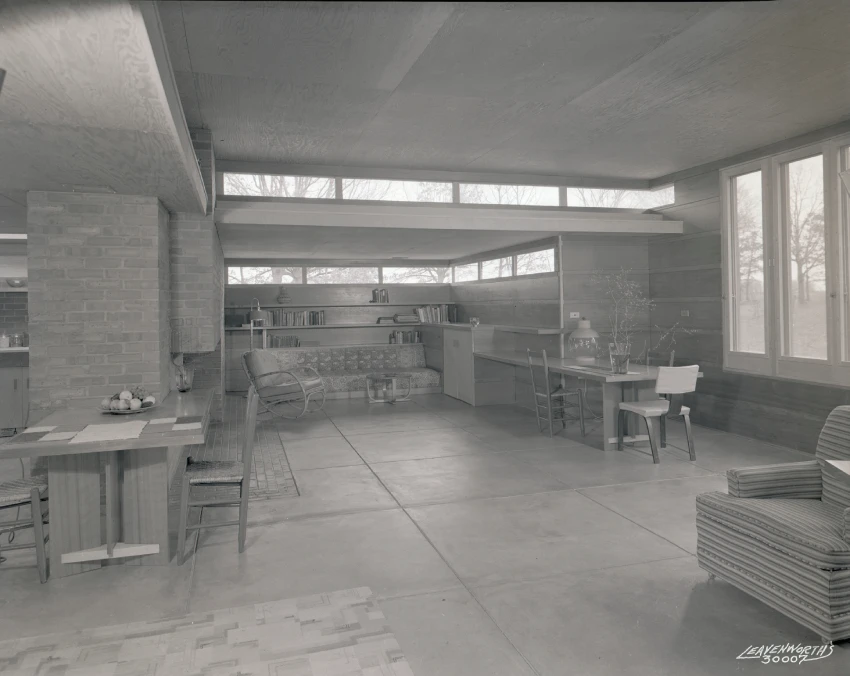
“Goetsch-Winckler house”, Oct. 19, 1940.
Courtesy the Archives of Michigan Digital Collections.
Wright Again
On July 29, 1947—seven years after construction—Goetsch and Winckler, feeling they were outgrowing their space, wrote to Wright and expressed interest in adding a third bedroom.
Wright obliged and sent them an altered floorplan that tucked a third bedroom behind Winckler’s, accessed by a narrow hallway extending behind the brick privacy wall to the north. However, it was quickly determined that the addition would encroach too closely on the property line, and the plan was ultimately never realized.
However, Goetsch and Winckler proposed a more ambitious idea: they would have Wright design them a larger home.
In November 1947, Wright was invited to give a lecture at Michigan State. While in the area, he visited Goetsch and Winckler and accompanied them to a new property they had purchased in the area, intended as the site for their next home.
By August 1948, a contour map had been completed. Goetsch and Winckler requested a more compact design with either three bedrooms or two bedrooms and a studio, as well as storage and low shelving throughout. A few days later, Wright delivered final schematic plans.
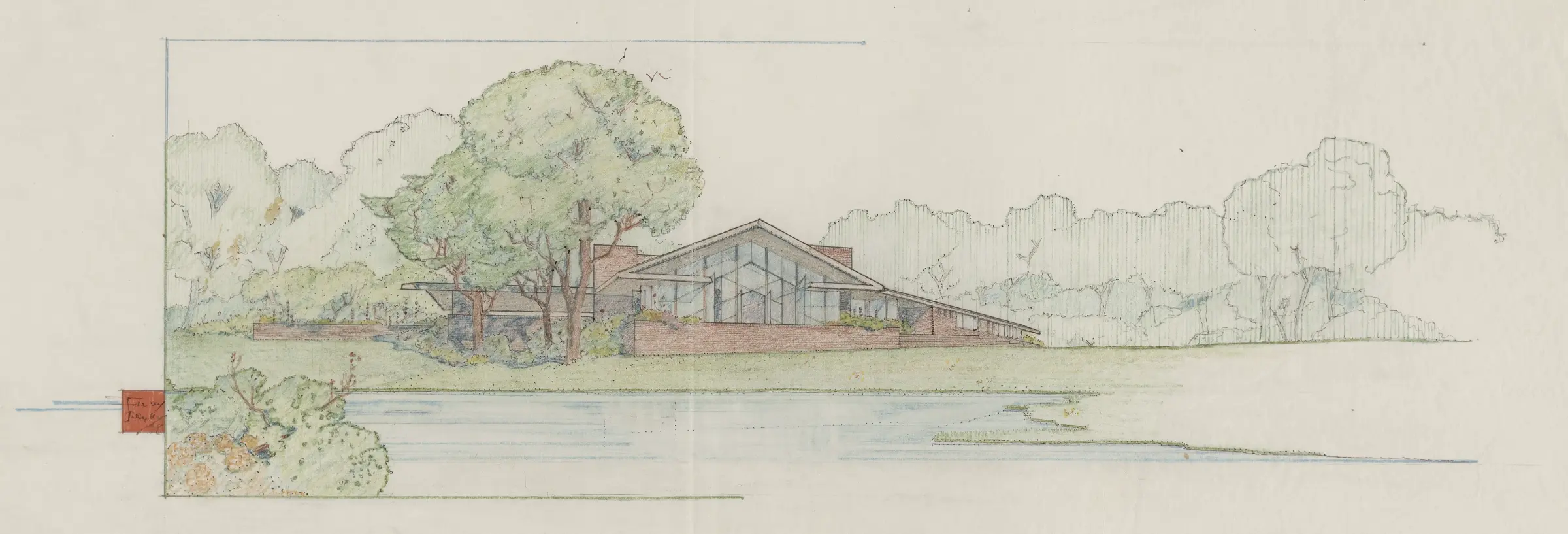
Goetsch–Winckler II illustration, Frank Lloyd Wright
This time, financing was not the obstacle—mortgage brokers were eager to support the project. The challenge lay in securing a builder. It was not until March 1953 that they were able to hire the Chamberlain Taylor Construction Company. Unfortunately, even after incorporating cost-saving substitutions, the estimated cost still remained prohibitively high.
Though only a decade had passed since the original Usonia II project, the climate had changed. Following the success of Wright’s Fallingwater and the postwar economic boom, Wright had become increasingly sought after by wealthy clients. His focus had mostly shifted away from affordable homes for middle America. The new design, while beautiful, was too large, too elaborate, and ultimately beyond Goetsch and Winckler’s means. They had been priced out of Wright’s work, and so the project was abandoned.
Though the home was never built, modern 3D modeling and rendering technology has made it possible to envision what might have been.
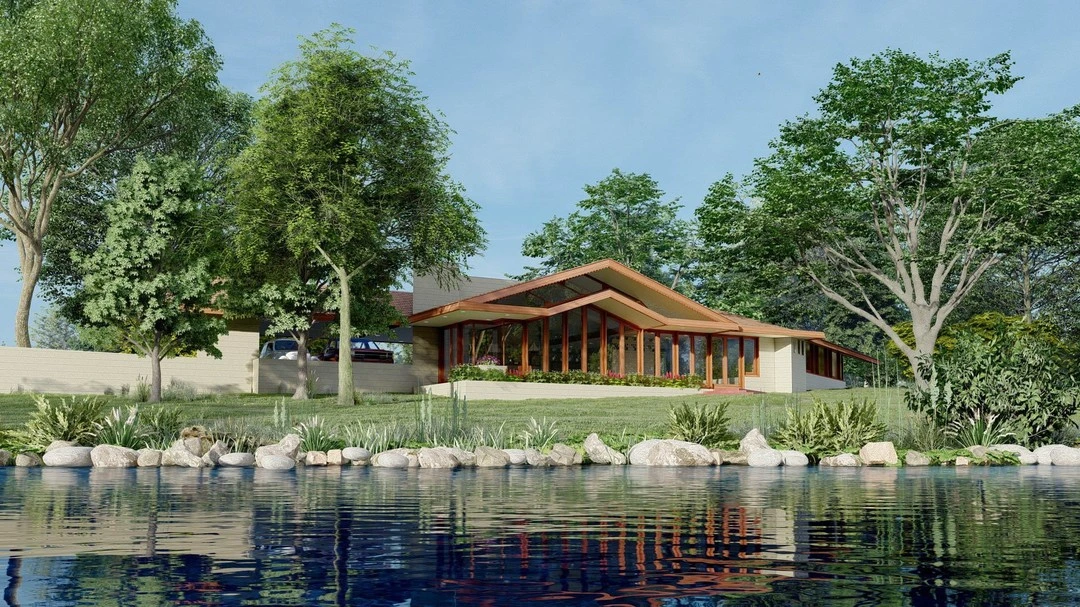
Goetsch–Winckler II model and render by Hugo Avila, Dec. 28, 2020 / Avila Arquitectos
Retirement
Goetsch and Winckler continued living in their modest Usonian until it came time for them to retire. In the early 1960’s, the two women concluded that they would leave Michigan in hopes of finding a new place to call home wherein they’d live out the remainder of their lives.
It was important to them to settle in an area with a more temperate climate, less harsh winters, and a community valuing art and culture (ideally near a university). Although they had considered Oklahoma and North Carolina, their search eventually led them to Fayetteville, Arkansas.34
Ten years prior, in 1953, architect E. Fay Jones and his family visited Goetsch and Winckler at their Wright-designed home in Michigan. Jones, an apprentice of Wright’s, was the only one of his disciples to have received the AIA Gold Medal—the highest honor awarded by the American Institute of Architects—and, conveniently, also worked extensively in Fayetteville and the surrounding region. The two women were already familiar with Jones’s work from a publication in “Progressive Architecture, House Beautiful”, and asked Jones to design their retirement home for them.35
They then purchased a sloping site near the peak of Mt. Sequoyah and were excited about working with the architect. In a letter to Jones, Goetsch wrote: “We keep congratulating ourselves that we know how to pick the right architect.”36
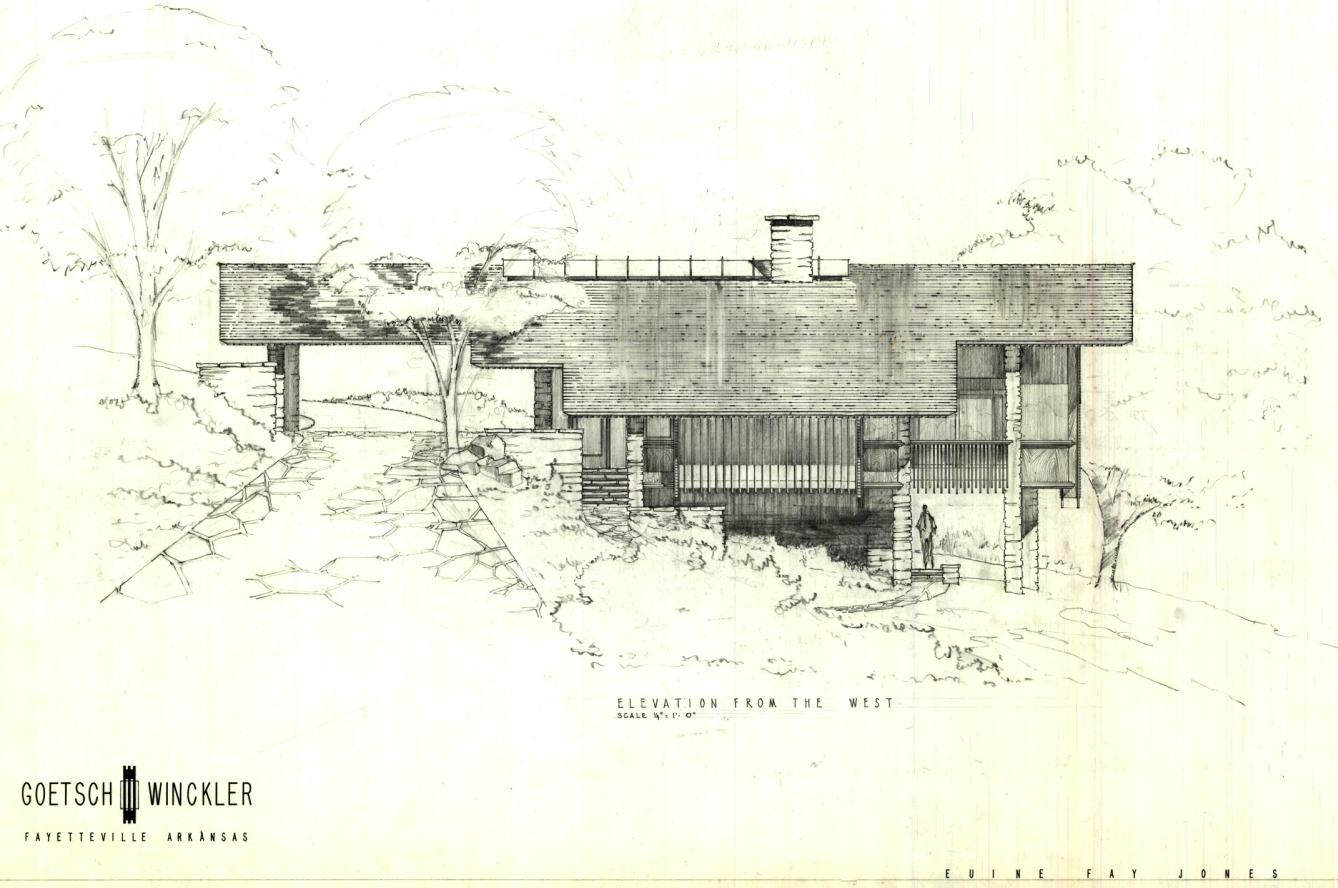
Goetsch–Winckler III, Elevation from the West, E. Fay Jones
Jones admired the Goetsch and Winckler’s original Wright house and was very aware of its esteem, so the concept of working with two of his mentor’s former clients was initially intimidating to Jones.37 When the women first approached Jones about designing a house for them, he was worried that they would want another “Wright House”. However, he was relieved when they described something entirely different: rather than requesting a duplicate, they were eager for a completely unique architectural form for this new phase of their lives—and Jones gave them just that, which he named “Goetsch–Winckler III”.38
The differences in their two houses was stark. In Michigan, their home sat on a nearly flat site with an open yard, but their home in Arkansas was situated in a deeply wooded lot near the peak of Mt. Sequoyah, featuring a steep incline which provided scenic views southward towards the Ozarks.
As for the specific details of the house itself, Goetsch and Winckler requested a gabled roof with a deep overhang, preferring it to the troublesome flat roof of their former home.39 They also requested the use of local materials wherever possible, and asked that light-toned wood and natural flagstone be incorporated throughout. This was notably opposite the richer wood tones and the precise red concrete floor grid of their Wright-designed home.40
Goetsch and Winckler moved to Fayetteville in 1966 so as to help oversee the construction of their new house.41 Not long after, they were moving in to their new masterpiece. Jones had perfectly realized their vision, creating a completely different and refreshing architectural form.
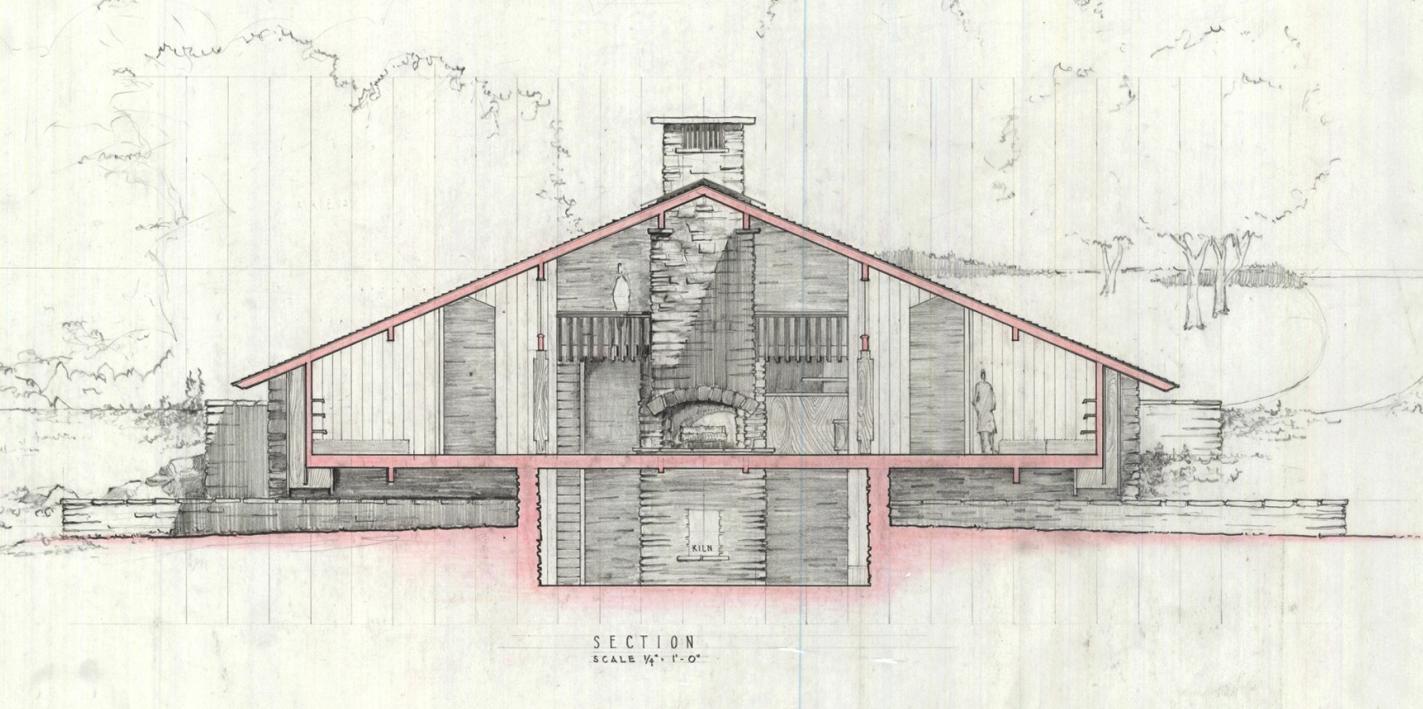
Goetsch–Winckler III cross-section, E. Fay Jones
Jones’s design for the two women was a home that was bilaterally symmetrical—one half for Goetsch, and the other half for Winckler.42 The two halves of the home were mirror images of one another, each with their own bathroom and exterior balcony, joined in the middle by a large, central fireplace and communal seating area.43
Although the two women had mentioned to Jones they were happy to share a studio space in which to produce their art, Jones designed two separate art studios, each based on the women’s individual needs and habits.
Goetsch, who described herself as a “sunshine daytime person”, was given the studio on the upper floor. This space had an abundance of natural light due to numerous skylights above while also wrapping around the central core of the home with balconies overlooking the communal space and hearth.44
Winckler on the other hand described herself as a “brooding, chain-smoking, nocturnal worker” and, in kind, Jones had reserved for her an art studio in the basement.45 This studio could be entered from the exterior and also provided a convenient space for her to install a kiln within the stone of the fireplace—a feature she was very enthusiastic about.
Both women were quite happy with their arrangements.
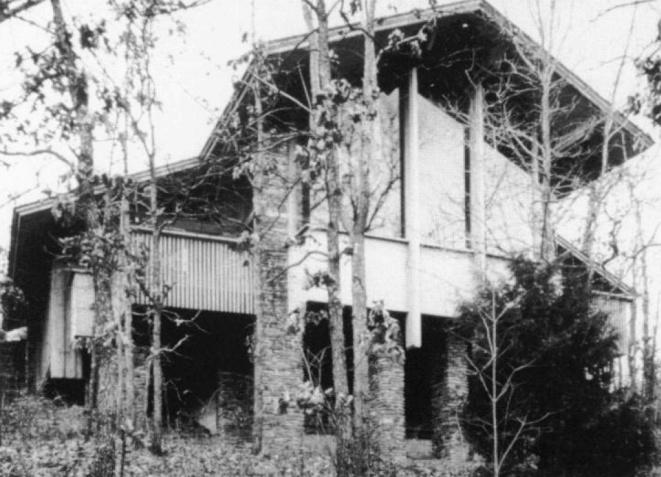
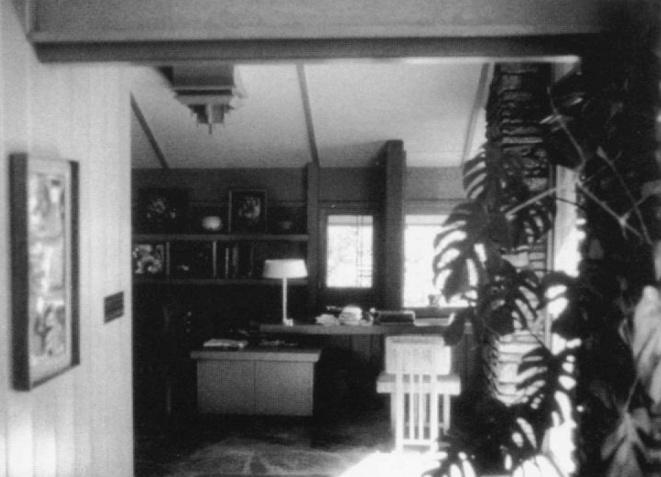
Goetsch–Winckler III, photographs of southern exposure and interior, E. Fay Jones
An Empty Half
Goetsch and Winckler were very excited to start their new life in Arkansas. Tragically, however, shortly after the women moved in to their new home, Goetsch fell gravely ill. She had developed cancer and passed away in April of 1968—less than three years after her retirement.
The loss of her lifelong companion was devastating for Winckler. Their two homes had embodied not just a shared devotion to art and architecture, but their lifelong bond. Now, the empty second half of their retirement home made Goetsch’s absence impossible to ignore—architecture that was designed to house a partnership made Winckler’s grief visible.
Winckler’s family reported that she was never able to work on her art again, didn’t like to dwell on the past, and became very reclusive, living out the rest of her days looking out the large glass windows facing out towards the Ozark mountains.46 She never did end up installing her cherished kiln.
In 1976, just eight years after Goetsch‘s death, Winckler also quietly passed away. They both left no direct heirs.
Legacy
While their homes represented their shared vision, Goetsch and Winckler’s story is equally about their partnership and determination to live life on their own terms. As unmarried women in a time when societal norms often limited their choices, they built a life that prioritized their professional goals and creative ambitions.
Their collaborations with Wright and E. Fay Jones resulted in homes that exemplified modernist principles in everyday living. Their shared vision, friendship, and courage to pursue an unconventional path have left a lasting legacy, demonstrating the power of architecture to challenge norms, inspire creativity, and shape the way we live.
Goetsch and Winckler spent thirty-seven years as close friends and confidants—they shared the stresses and joys of planning multiple homes together and, in so doing, they built a bond deeper than many marriages.
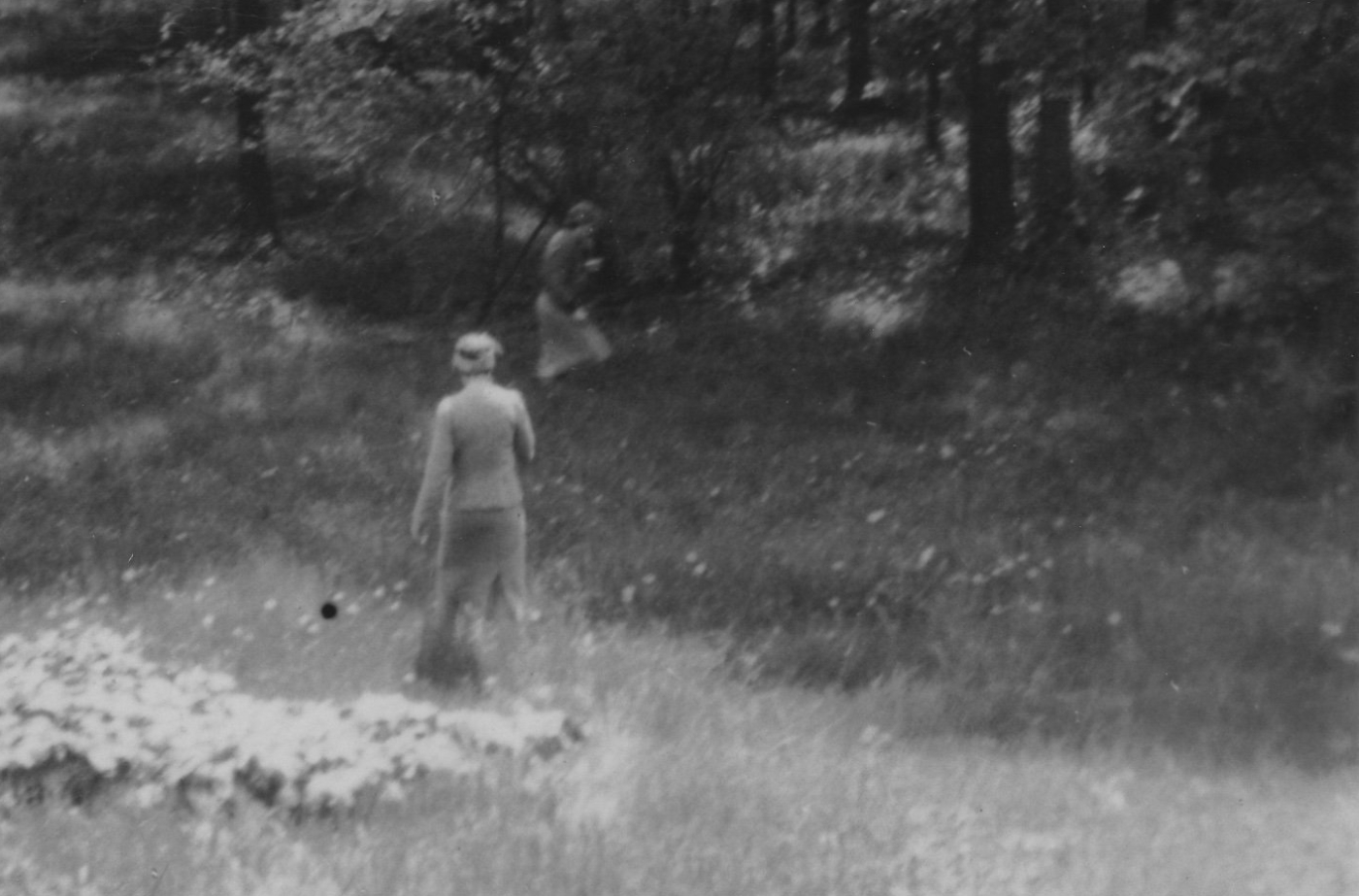
Courtesy the Frank Lloyd Wright Foundation, Scottsdale, AZ.
After Goetsch and Winckler
Following Goetsch and Winckler’s retirement and subsequent move to Arkansas, their home was first sold in 1966 to M. Amalle Vasold, and then three years later to Elizabeth Halstead, who lived there until 1992.47
Toward the end of Halstead’s stewardship, the house was nearing fifty years of age. So, in the summer of 1988, she contacted Ann Arbor–based designer and contractor Don Price to assess the home’s condition, with particular concern for the roof.48
With the assistance of an architect, Price conducted a thorough inspection and identified several areas of serious concern: the south wall of the studio living room had bowed significantly, preventing the casement windows from opening; the cantilever over the carport had sagged considerably; and the built-up gravel and tar roof showed cracking and signs of leakage.49
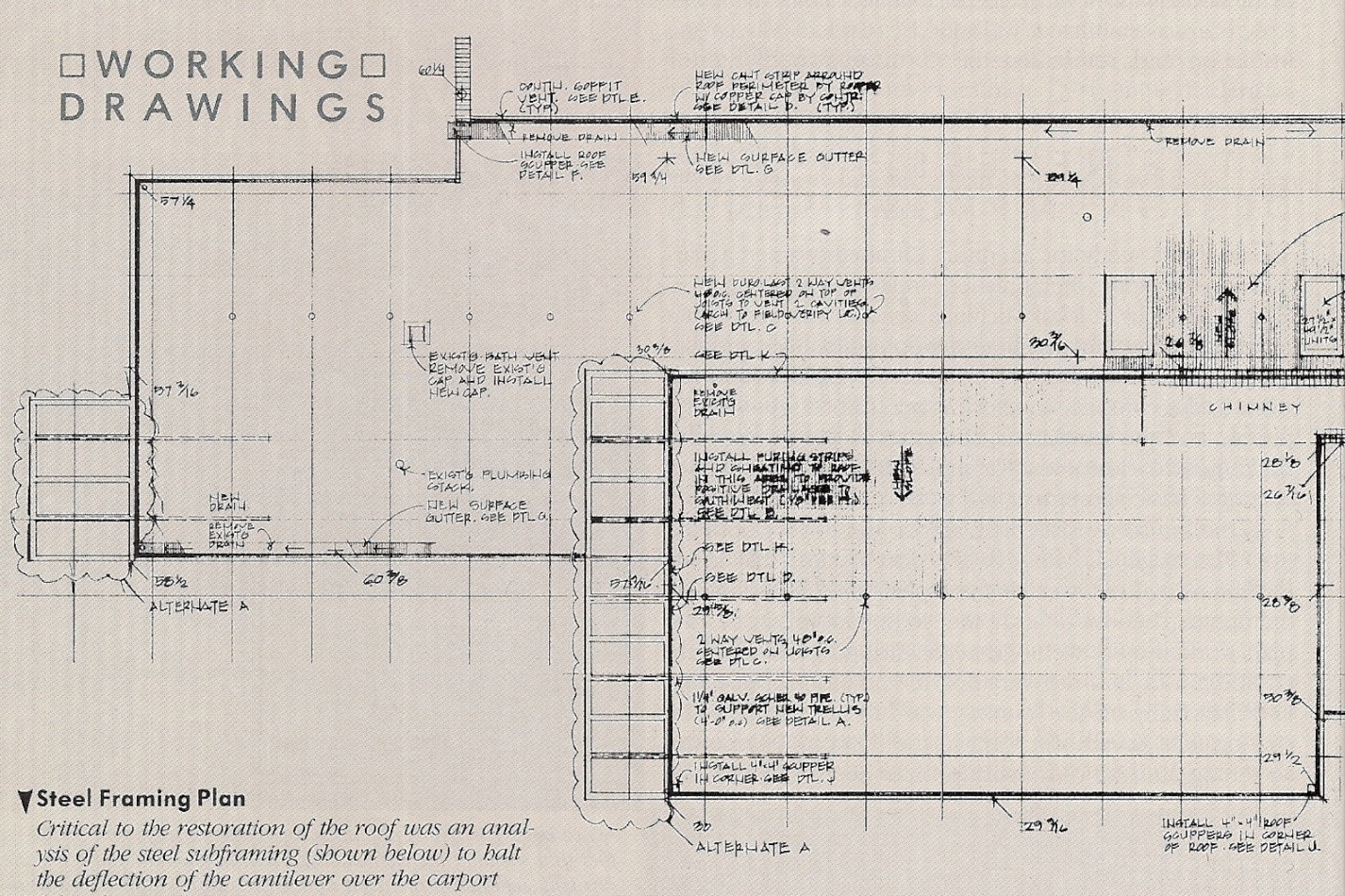
Working drawings for Goetsch–Winckler House, Don Price, c. 1988
Before addressing the roof and cantilever, they first needed to repair the south wall. The framing behind the brick planter box had separated, breaking the top soldier course and forcing it downward, which in turn caused the windows to point inwards toward the interior of the home.50
The roof was slowly raised until the framing was plumb again, and the damaged lower wall structure was removed and rebuilt. New masonry piers were installed beneath each window to provide proper support, and the assembly was secured and grouted to stabilize the wall before further work continued.51
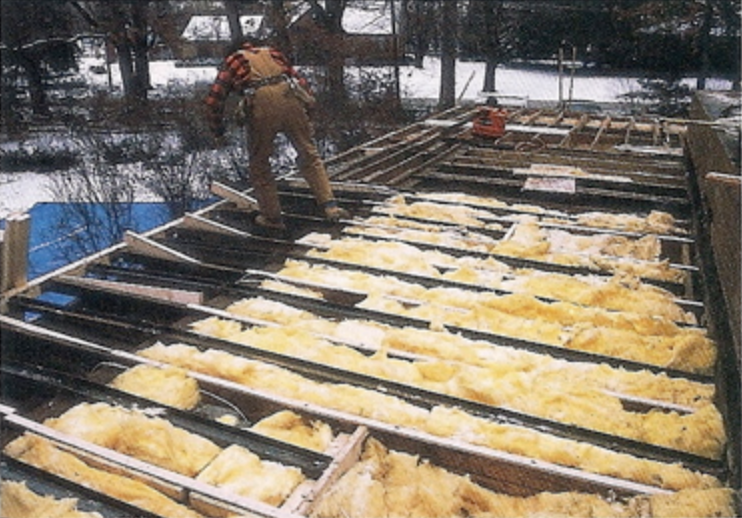
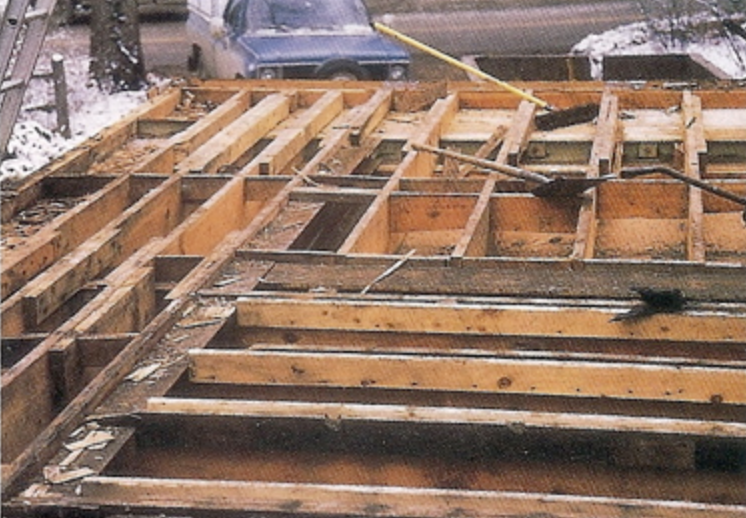
Goetsch–Winckler exposed roof framing, Ralph Turner, c. 1988
With the south wall stabilized, the next priority was to straighten the cantilever over the carport, where long-term sagging had become increasingly pronounced. As the sheathing was removed, it became clear that the issue was not simply age, but insufficient structural support compounded by decades of deflection.52
To address the ongoing movement, further reinforcement was required. A steel diaphragm was anchored to the chimney mass to provide a more secure point of support, and the primary beam was strengthened to reduce twisting. Additional steel members were installed above the kitchen and integrated into the soffit, forming a more rigid structural system capable of supporting the cantilever over time.53
With the new steel in place, the structure was brought back into alignment.54 While the intervention altered the unseen structure, it preserved the outward appearance of the cantilever, allowing the house to retain one of its most distinctive architectural features. More than thirty years later, deflection remains minimal, indicating the effectiveness of the intervention.
Now that the cantilever framing was sorted, the roof was ready for attention.
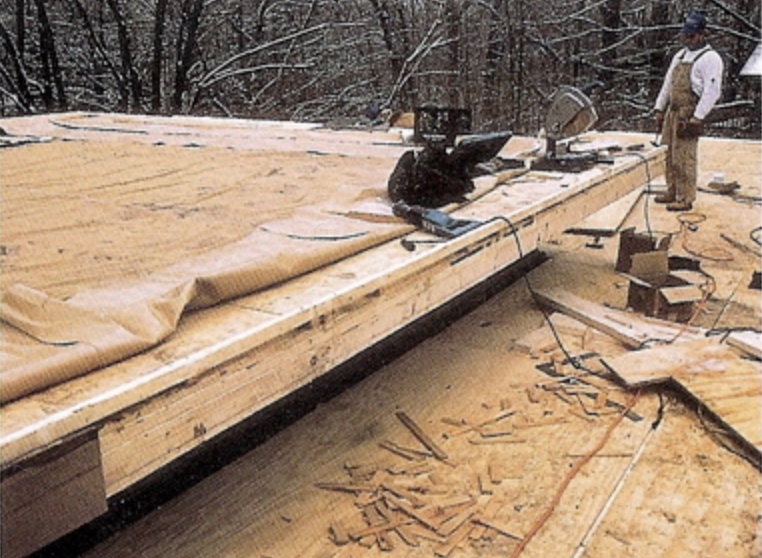
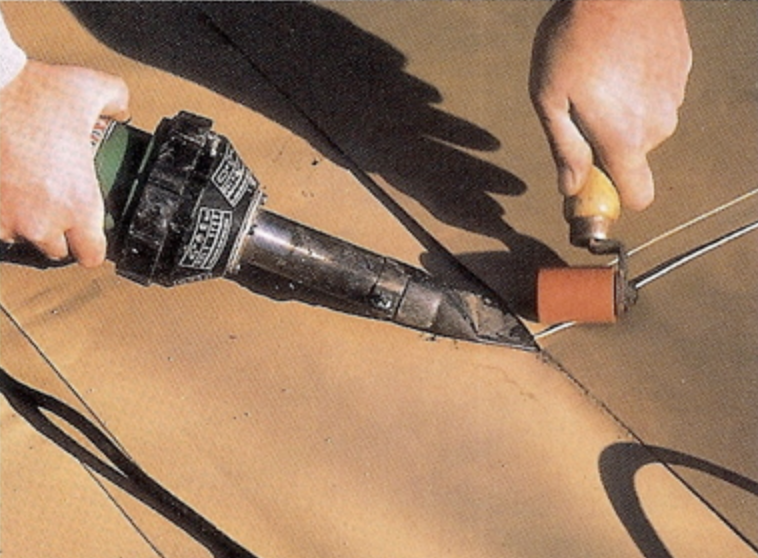
Membrane installation, Ralph Turner, c. 1988
The existing built-up tar and gravel roof was removed and replaced with a Duralast membrane system, addressing long-standing issues with deterioration and leakage. The new system provided a more durable, continuous surface better suited to protecting the structure over time.55
To improve drainage, an internal gutter system and scupper were added, the two-inch drains were widened to four inches to minimize clogging, and a slight pitch was also introduced to the upper roof to better encourage runoff while still maintaining the appearance of a flat roof.56 Together, these changes significantly improved the roof’s performance without significantly altering the overall character of the house.
Unfortunately however, due to cost constraints, the overhanging trellises, which had rotted through, were removed and not replaced.57
With all of the home’s repair issues addressed, the house was more structurally sound and better equipped to endure another fifty years of life. Just a few years later, in December of 1995, the home was added to the National Register of Historic Places (NRHP reference No. 95001423).
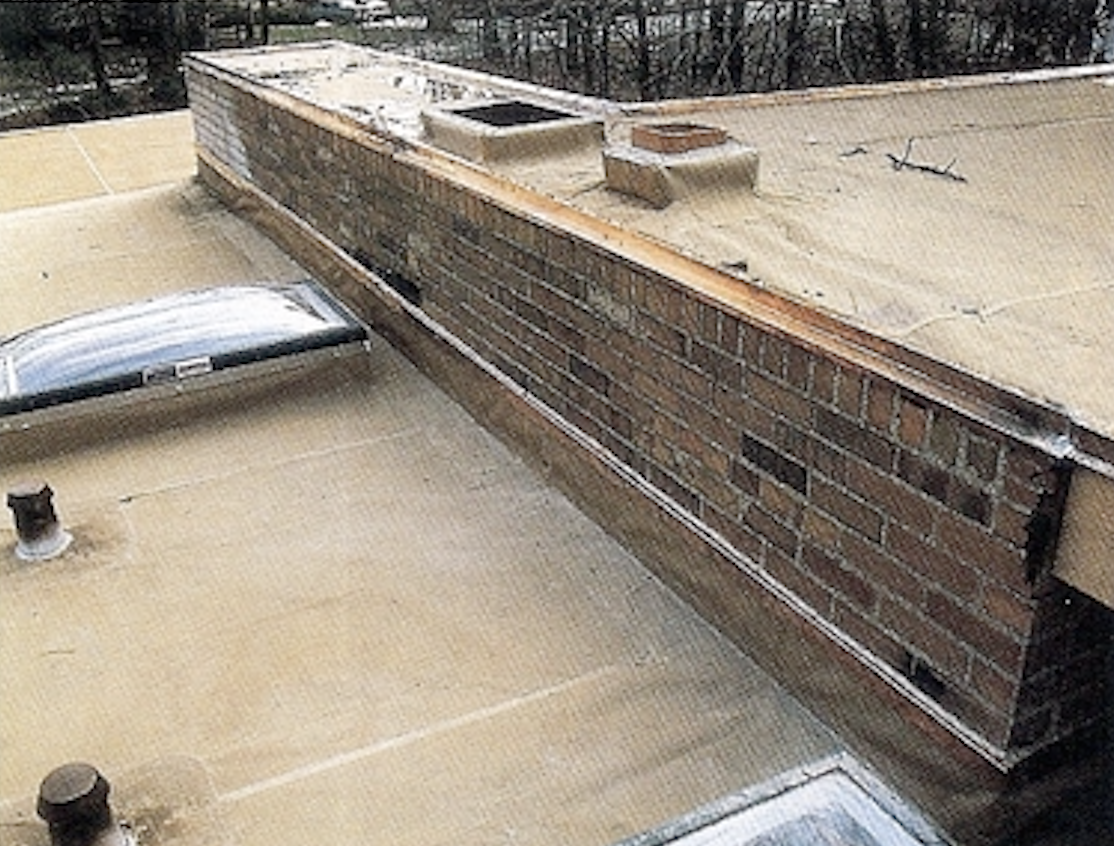
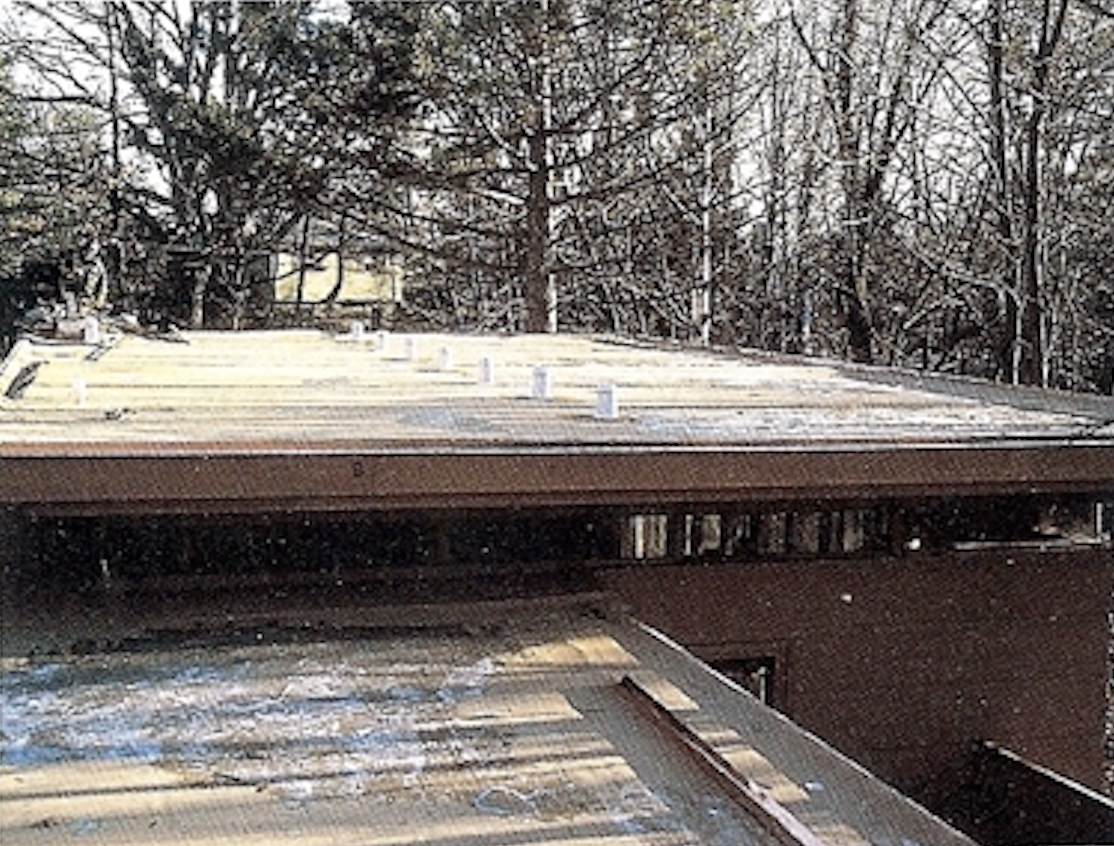
Completed membrane roof, Ralph Turner, c. 1988
Nearly Demolished
Despite Halstead’s careful stewardship, the house was neglected and fell into disrepair under subsequent ownership in the early 2000’s, ultimately putting it at serious risk of foreclosure and demolition.
A Brazilian architect purchased the home while teaching at Michigan State University and lived there during his appointment. When his position ended, he returned to Brazil but retained ownership of the home. He rented it on an ad-hoc basis to students, but for the most part it didn’t receive adequate care or maintenance. The property became overgrown, the roof began to fail, and a tarp was installed over the roof as a temporary measure to keep water out.58
Concerned by the visible decline, passers-by and local advocates contacted the Frank Lloyd Wright Building Conservancy (https://savewright.org), one arm of Wright’s legacy primarily concerned with protecting and preserving his extant works as well as providing resources to homeowners.
When the Conservancy reached out to the owner, they learned the house was already in foreclosure and nearing the end of the redemption period, and the lender was already in talks with a property developer who was only interested in the land. With no more than three days left before the property was to be auctioned, the situation had become urgent.59
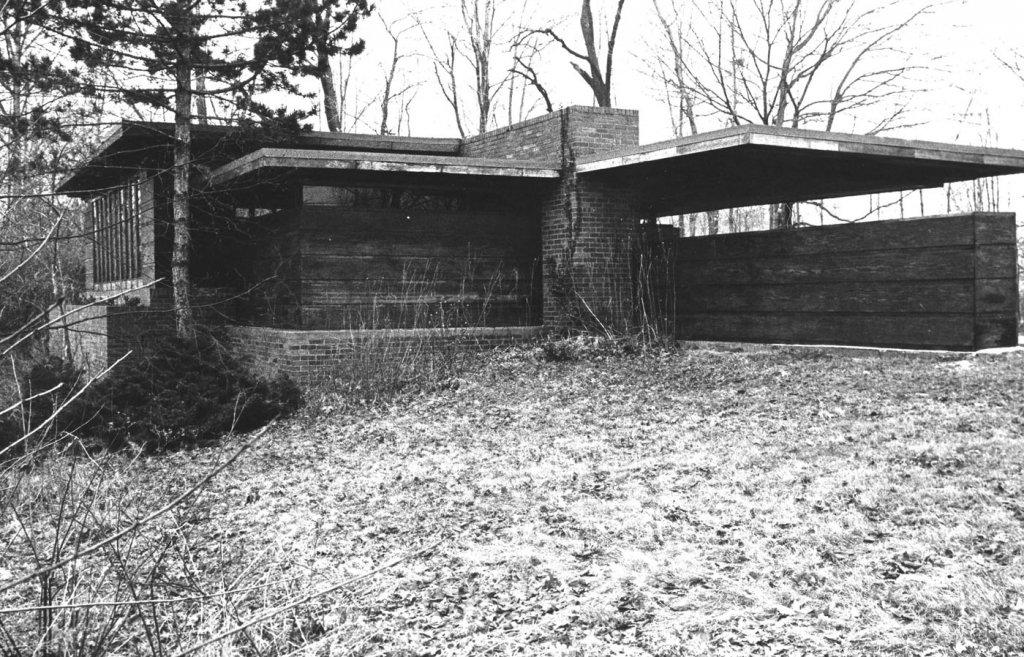
Goetsch–Winckler House, Unknown photographer
An emergency meeting of the Conservancy’s board was held, and a decision was made to act. Using its revolving fund, the Conservancy moved to satisfy the outstanding mortgage and prevent the loss of the house. The transaction was completed just in time, bringing the property out of foreclosure and into safe hands.60
With the immediate crisis resolved, the Conservancy began searching for a sympathetic buyer who would take on the duty of responsible stewardship. The house was ultimately transferred with a preservation easement in place—a legal covenant attached to the property that governs how it can be altered and protects key architectural features over time.61
While easements are often associated with historic districts—such as the French Quarter in New Orleans—and typically focus on preserving exterior façades, the Goetsch–Winckler house is subject to a far more comprehensive agreement.
Goetsch–Winckler’s easement protects not only the exterior, but also the interior, all original furnishings, and the surrounding land, trees, and elevations. It also requires that the house be opened to the public no fewer than four days each year. Because the easement is recorded with the deed and runs with the land, these protections remain in force regardless of future ownership, ensuring long-term stewardship of the house in its entirety.62
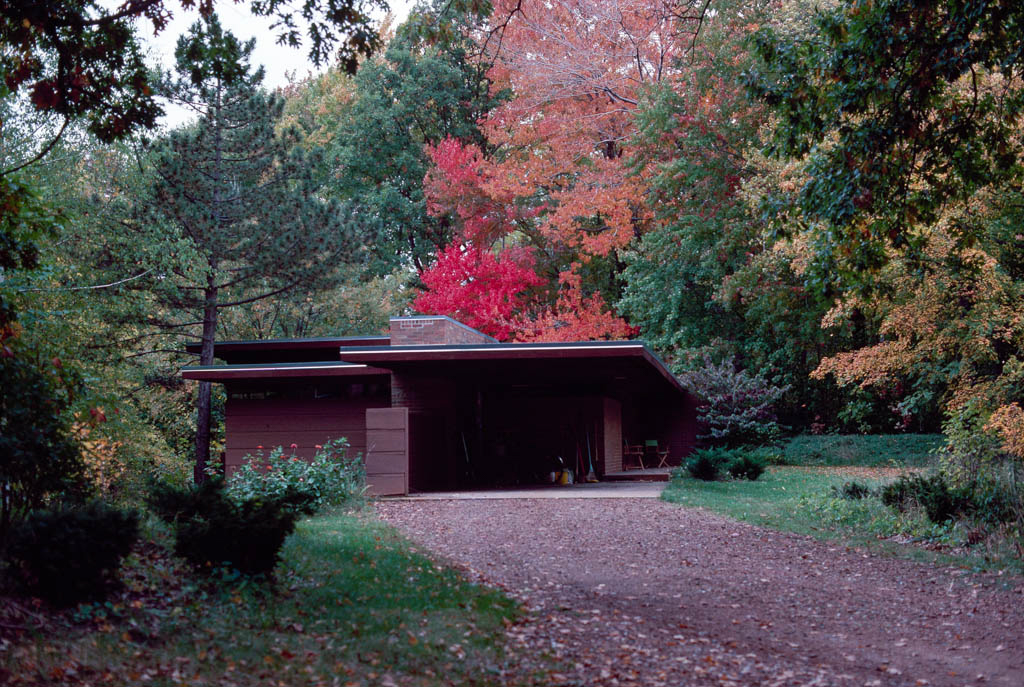
Photograph by Balthazar Korab, Unknown year
Present Day
Following its rescue, the house entered a period of sustained restoration and careful stewardship. In 2007, Audrey and Dan Seidman acquired the property and undertook a comprehensive, multi-year restoration. Over more than a decade, they repaired and stabilized the structure, restored damaged finishes, and upgraded critical systems, bringing the house back into livable condition while respecting its original design.63
In the years that followed, additional exterior work was carried out, continuing the process of long-term preservation. This included restoration efforts led by Douglas DelGrosso between 2020 and 2023, which primarily addressed stripping the paint from the exterior to reveal the natural wood grain.64
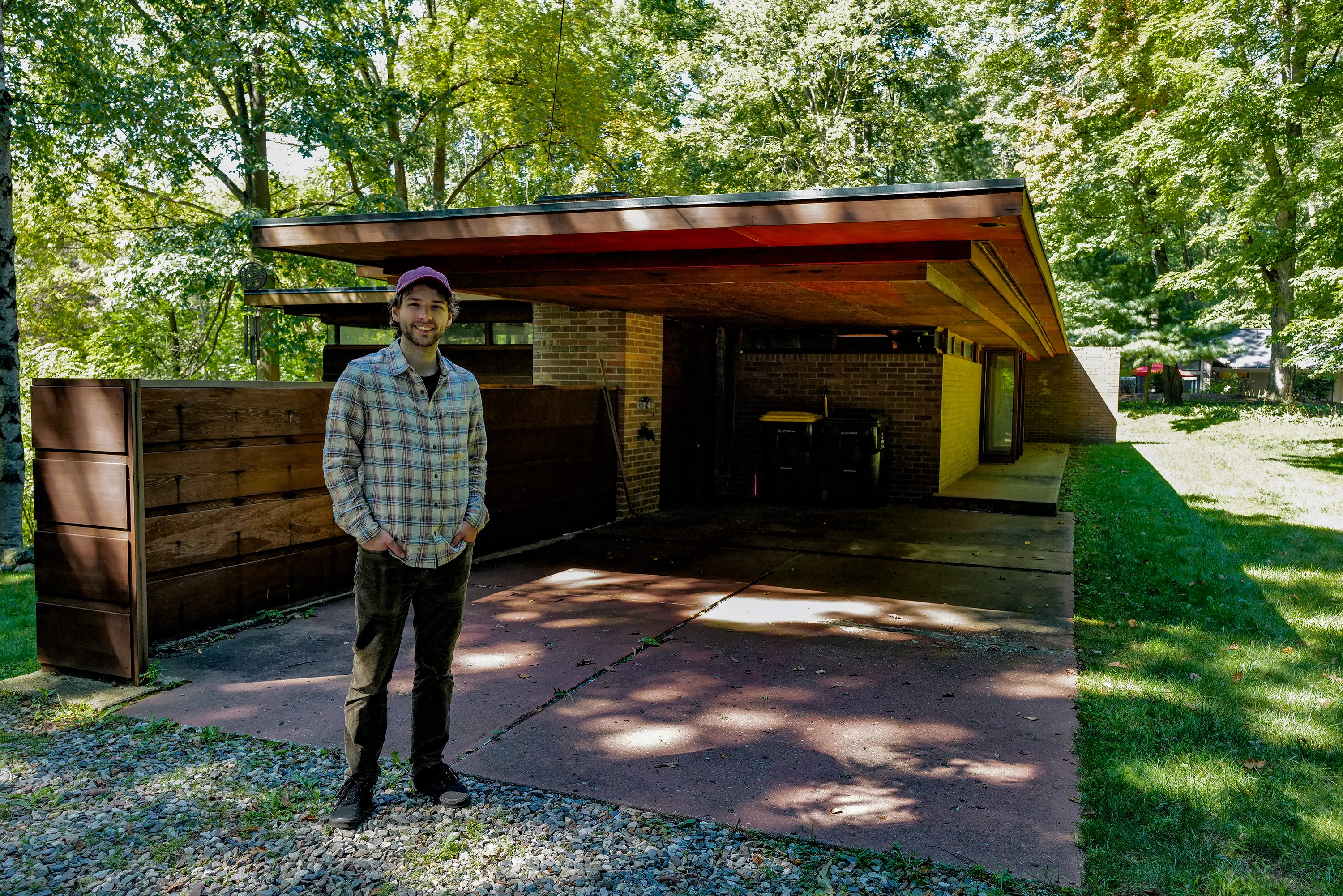
Nate Meyer stands in front of Goetsch–Winckler house, Sep. 2024. Robert Killips | Lansing State Journal
In 2023, the house was purchased by Nate Meyer and his wife, marking the beginning of a new chapter focused on access and engagement. Their stewardship, as well as the decision to open the house to the public through regular free tours, overnight stays, art shows, and other events, has been widely covered in national and regional press, including The New York Times, Architectural Digest, and the Lansing State Journal. These accounts underline both the challenges of maintaining a Wright house while balancing the growing interest in making such spaces accessible to a broader audience.
This effort has also extended into digital access through the launch of this dedicated website, a 3D virtual tour, and an active presence on social media (@goetschwincklerhouse), allowing the house to be experienced by those unable to visit the home in person, all while also helping to broaden awareness of Frank Lloyd Wright’s work.
Today, the home is more accessible than ever before. For the current owners, the house is best preserved not as a museum, but as a space that can be experienced by all—one that continues to be lived in, cared for, and meaningfully shared with others.
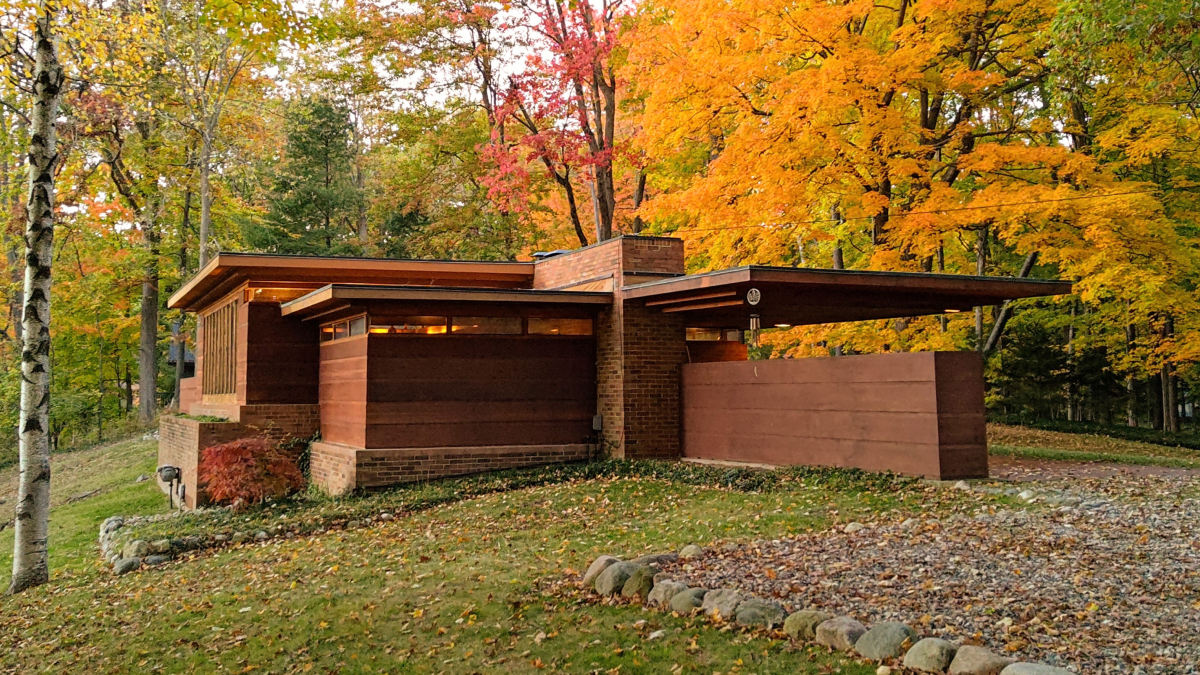
Photograph by Nate Meyer for @goetschwincklerhouse / CC BY-NC-ND 4.0
Footnotes
- 1 Salome Winckler Wells, telephone interview by Anatole Senkevitch Jr., August 16, 1988, cited in Diane Tepfer, “From Frank Lloyd Wright to E. Fay Jones: Alma Goetsch and Kathrine Winckler, Ordinary Extraordinary Architectural Patrons,” in Affordable Dreams: The Goetsch-Winckler House and Frank Lloyd Wright (East Lansing: Kresge Art Museum, Michigan State University, 1991), 29.
- 2 “Data on Faculty of Michigan State,” Michigan State University News Bureau; information provided by Mary McGuisick, archivist, School of the Art Institute of Chicago; cited in Tepfer, “From Frank Lloyd Wright to E. Fay Jones,” 29.
- 3 Tepfer, “From Frank Lloyd Wright to E. Fay Jones,” 29.
- 4 Wells, telephone interview, cited in Tepfer, “From Frank Lloyd Wright to E. Fay Jones,” 31.
- 5 Winckler and Goetsch, East Lansing, to Frank Lloyd Wright, Taliesen, “The Idiosyncracy Letter,” October 25, 1938, in Affordable Dreams, xxiv–xxv.
- 6 Ibid.
- 7 Ibid.
- 8 Tepfer, “From Frank Lloyd Wright to E. Fay Jones,” 33.
- 9 Ibid.
- 10 Ibid.
- 11 Ibid.
- 12 Winckler and Goetsch, “The Idiosyncracy Letter,” xxv.
- 13 Ibid.
- 14 Tepfer, 36.
- 15 Anatole Senkevitch Jr., “Usonia II and the Goetsch-Winckler House: Manifestations of Wright’s Early Vision of Broadacre City,” in Affordable Dreams, 13 and 26n48.
- 16 Tepfer, 35.
- 17 Harold Turner, East Lansing, to Wright, June 14, 1940; cited in Tepfer, 37.
- 18 Cheryl Snay, “Chronology,” in Affordable Dreams, xxi.
- 19 Tepfer, 36.
- 20 Ibid.
- 21 Snay, xxi.
- 22 Tepfer, 35.
- 23 Ibid.
- 24 Winckler to Wright, July 23, 1939; cited in Tepfer, 36.
- 25 Ibid.
- 26 Robert C. Twombly, Frank Lloyd Wright: His Life and His Architecture (New York: John Wiley & Sons, 1979), 242.
- 27 Harold Turner to Wright, June 14, 1940; cited in Tepfer, 37.
- 28 Tepfer, 37.
- 29 Snay, xxii.
- 30 Tepfer, 37.
- 31 Ibid.
- 32 Wright to Goetsch and Winckler, August 23, 1940; cited in Senkevitch, 25.
- 33 Susan J. Bandes, foreword to Affordable Dreams, xi.
- 34 Tepfer, 39
- 35 Ibid.
- 36 Alma Goetsch, East Lansing, to Fay Jones, Fayetteville, January 24, 1966. Fay Jones Special Collections (MC 1373), Series II, Subseries 1, Box 21, File 11. Special Collections, University of Arkansas Libraries, Fayetteville. Correspondence between Jones and Alma Goetsch and Kathrine Winckler, East Lansing, is from the Fay Jones Special Collection in the University of Arkansas Library Archives. Unless otherwise noted, all letters to and from Jones cited below are from the Jones Special Collection.
- 37 Jones shared this thought with Diane Tepfer during an interview 25 years after the construction of the house. Ibid.
- 38 Tepfer, 39.
- 39 Ibid.
- 40 Ibid., 42.
- 41 Ibid.
- 42 Ibid., 40.
- 43 Calli Verkamp, A Study of the Influence of Women Clients on Residential Architectural Design through the Work of E. Fay Jones (Architecture Undergraduate Honors Thesis, University of Arkansas, Fayetteville, May 2013), 59.
- 44 Verkamp, A Study of the Influence of Women Clients, 61–62.
- 45 Ibid.
- 46 Diane Tepfer, “Alma Goetsch and Kathrine Winckler: Patrons of Frank Lloyd Wright and E. Fay Jones,” Woman’s Art Journal (Fall 1991/Winter 1992).
- 47 Snay, “Chronology,” xxi.
- 48 Don Price, “Cantilever Tales: An Old Modern Gets a New Roof,” Old House Journal, May/June 1990, 42.
- 49 Ibid.
- 50 Ibid.
- 51 Ibid.
- 52 Ibid., 46.
- 53 Ibid.
- 54 Ibid.
- 55 Ibid., 44.
- 56 Ibid., 45.
- 57 Ibid.
- 58 Ronald P. Duplack, “Quick Action Saves Goetsch-Winckler House,” SaveWright Magazine, Spring 2012, 10.
- 59 Ibid., 10–11.
- 60 Ibid., 11–12.
- 61 Ibid., 12–13.
- 62 Frank Lloyd Wright Building Conservancy, “Easements,” accessed May 2, 2026, https://savewright.org/easements/